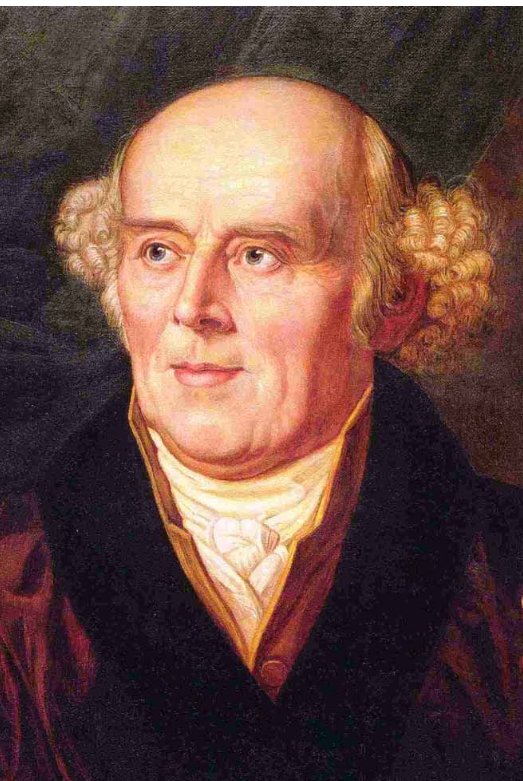
In the 18th century when the medical field was in a chaotic condition, Germany presented to the world Dr. Christian Friedrich Samuel Hahnemann, the man with the mission to cure. The study of system of Homoeopathy remains incomplete without the study of the life history of Hahnemann, because his life history itself is the origin and development of Homoeopathy. Hahnemann belonged to the group of fighters who achieved great heights in their respective fields inspite of most unfavorable and discouraging circumstances.
Birth
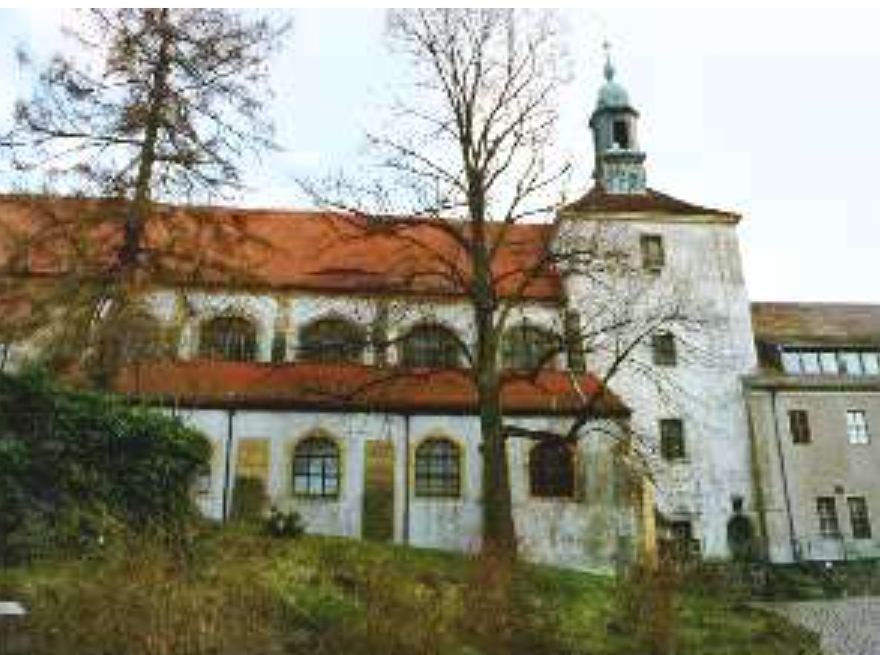
Samuel Christian Frederick Hahnemann, the founder and father of Homoeopathy was born on 10th April 1755, in a small town in Germany, called Meissen, in the state of Saxony.
Early life and Education
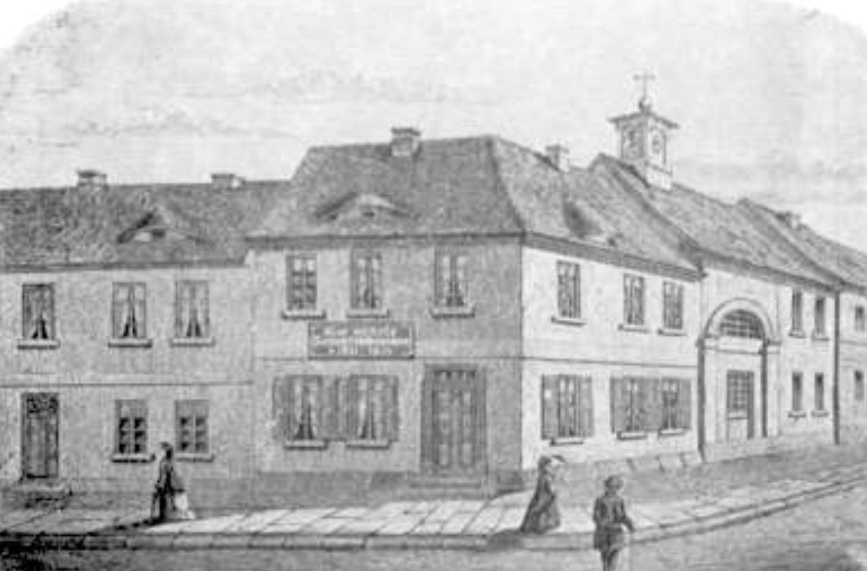
His father, Christian Gottfried Hahnemann was a porcelain painter, in a porcelain factory in town. Hahnemann’s father was a poor man, and therefore could not afford to send him to school. Although Hahnemann did not spend his early days going to school, it did not stop him from getting his education. He got his early education at home, from his father. Hahnemann’s father taught him to lead a straightforward life, a life which was true one without any pretence.
At the age of 13, in 1767, Hahnemann was admitted to a school. He turned out to be a very brilliant and intelligent student. He had worked his way into the hearts of all his teachers. He showed a lot of interest in Mathematics and Botany. His love for Botany was so great that he made his own herbarium. He was a linguist, and it was this great flair for languages that saw him through his harder days of life. Seeing his great command over the languages, he was asked by his teachers at his school, to teach his fellow students Greek and Latin. Later he learnt about 8 to 10 languages and had the working knowledge of each of them. After some time when his father could not afford his education, he got Hahnemann a job in a grocery store. Hahnemann had no intention nor desire to work. So he returned home to continue his studies.
After passing his school, he joined the Leipzig University in 1775 He earned his living by teaching German and French to other students. From Leipzig, he went to the Hospital of the Brothers of Mercy, at Vienna.
In 1779 i.e. 4 years after starting his medical career, he got his M.D Degree from the University of Erlangen on his thesis. “A consideration of the eliology and therapeutics of spasmodic affections” .
Medical Practice and Marriage
Thereafter, he started his practice in the town of Hettstedt. At the same time he was translating books from English to German. He was also writing for Kreb’s “Medical Observation”, and it was through these things that he became known in the medical world.
After a short stay of about a year at Hettstedt, he left for Dessau. At Dessau he met Mr. Haesler, a chemist and pharmacist. It was Mr. Hassler’s step-daughter Johanna Leopoldine Henriette Kuchler, whom Hahnemann finally, married on 17th November 1781. Hahnemann was 27 years old and his wife was 9 years younger to him. Hahnemann was appointed as a medical officer of health in Gommern city. In the year 1784, the couple had their eldest child Henrietta. Mr. & Mrs. Hahnemann had eleven children, during the years 1783-1806 A.D. Hahnemann was not satisfied with the cruel and uncertain methods After this he was mainly involved in translation of books for 4 years. In 1789 Hahnemann wrote his first Volume of, “Friend of Health”. He was very depressed and dissatisfied by the system of medicine that then prevailed. Later he started translating books.
Discovery of Homoeopathy
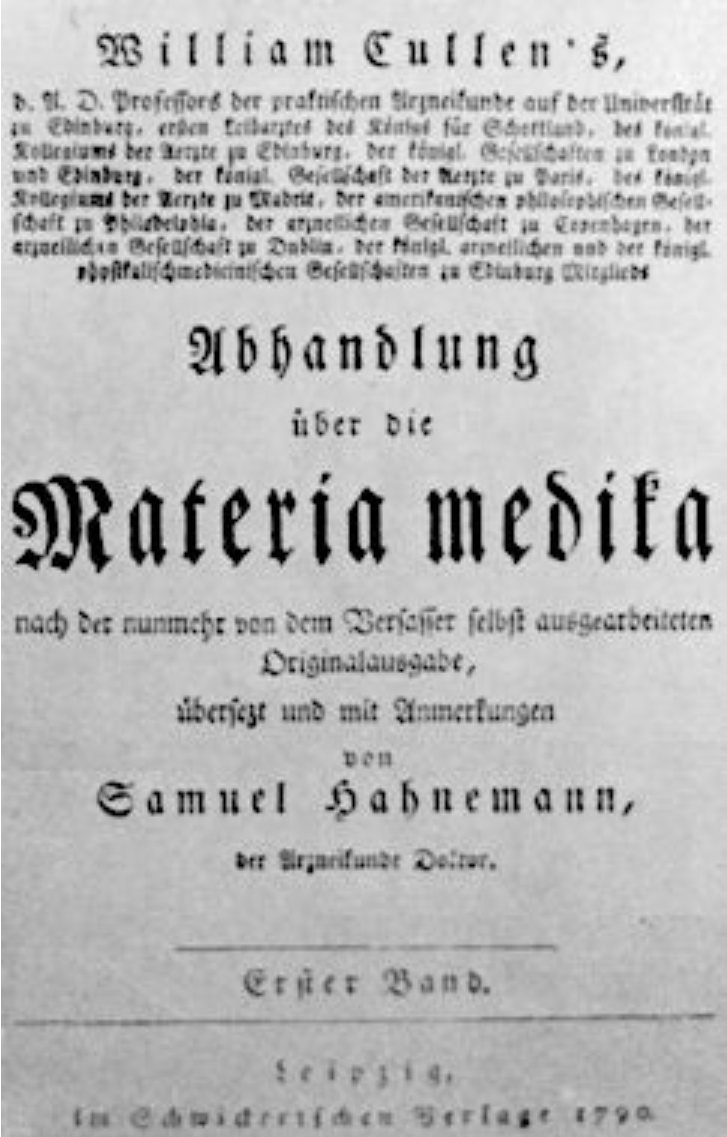
It was in 1790 while he was translating William Cullen’s, “Materia Medica,” that he found out that the effect of Cinchona juice on a person was the same as that of Malaria. He tried this drug out on himself and saw that it produced the symptoms of Malaria. This was the birth of “Homoeopathy”.
A great new branch of medicine was born. He then started experimenting with more and more drugs. He started experiments on himself first and then on members of his family, close friends and relatives. Se He noted the effect of each drug carefully and came to the conclusion that these drugs can produce disease and at the same time cure diseases which manifested symptoms similar to those of the drug.
In the year 1805 he published his “Medicine of Experience”, which could be called a forerunner to the “Organon of Medicine”. In 1810 the First edition of Organon i.e. “Organon of Rational Art of Healing”. was published.
Hahnemann’s life after the publication of “Organon of Medicine”
The release of this book put Hahnemann in great trouble. During 1811 to 1821 he wrote seven volumes of the Materia Medica Pura, in which the recording of symptoms of medicines, after they were proved on healthy human beings, were published. In 1819 he published the 2nd edition of “Organon of Medicines”. In the middle of 1821 he was given permission to re-start his practice of Homoeopathy in Koethen. In the year 1824 the 3rd edition of Organon was published. It was an improved edition and contained 320 aphorisms Five years later in the year 1829. the 4th edition of the “Organon of Medicine”, was published. It contained 292 aphorisms. The “Theory of Chronic Diseases” was introduced for the first time in this edition. The 5th edition was published in the year 1833, In this he introduced the doctrines of the Vital Force and Drug Dynamisation. The last and the final, the 6th edition, was published in the year 1921. This edition was published 78 years after the death of Hahnemann. Earlier in 1828 Hahnemann’s “Chronic Diseases” was published.
The life partner of master, the woman who stood beside him during the period of hardship, his wife Johanna passed away on 31st of March 1830 A.D. She spent about 40 years of married life with Hahnemann. The later years of his life Hahnemann dedicated fully to homeopathy, he was looked after by his daughters.
In 1835, Hahnemann met Madame Marie Melanie De Hervilly, a woman of a high French society. During the course of her treatment, he fell in love with her and got married. She was 45 years younger to him. This second marriage brought bright fortune to Hahnemann’s life. Soon after, the couple took their leave from Germany and moved to Paris. In Paris Hahnemann got recognition, success, honor, money, comfort and peace. It is believed that Melanie practiced homeopathy along with her husband in Paris, hence regarded as the first lady homeopathic practitioner.
Final Days of His life
Hahnemann, after a long hard and fruitful life, expired on 2nd July 1843 at 5 A.M. after giving the world the most Rational art of healing, Homoeopathy. The cause of his death was stated as Bronchial catarrh.
T.L. Bradford praised Hahnemann as “the scholar whom scholars honored and respected, physician whom physicians feared, philologist with whom philologists dreaded to dispute; chemist who taught chemists, philosopher whom neither adversity nor honor had power to change”.
Hahnemann’s life at a Glance (1755 to 1843)
1755 – 10th of April, Birth of Samuel C. F. Hahnemann, in Meissen (Germany).
1767 – Joined the Town School in the 2nd Standard.
1770 – joined the Prince’s School.
1775 – Gave his school leaving speech on. “The Wonderful Construction of the Human Hand.”
1779 – Hahnemann got his Medical degree of M.D., from the University of Erlangen on his thesis, “A consideration of the aetiology and therapeutics of spasmodic affections”. He was guided by Dr. Var Quarin.
In the same year he was made the Family Physician and librarian to the Governor of Transylvannia.
1781 – Went to Dessau. Here he met Mr. Haesler, a Pharmacist, and it was his step daughter, that Hahnemann later married.
1783 – Was appointed District physician in Gommern. He got married to Mr. Haesler’s step daughter Johanna Leopoldine Henriette Kuchler.
1785 to 1789 – He was mainly involved in literary work. He wrote books and translated several books into German from English
1789 – He went to Leipzig, He published his : (1) Treatise on Syphilis (2) “Friend of Health” (3) His Translation of Demachy’s (Frerch Chemist) “The whole sale manufacture of the chemicals or the science of chemical products in Factories” in 2 volumes. This translation got him a lot of fame.
1790 – It was this Historical Year, in which Hahnemann while translating William Cullen’s “A Treatise on Materia Medica came across the properties of the Cinchona Bark, thereby, accidentally discovering the Greatest and Only Rational Art of Healing. “HOMOEOPATHY“.
1792 – He took charge of an Asylum in Georgenthal in the Thuringian Forest. He mainly took up this job so that he could carry out investigations find out the universality of his Discovery
1795 – He migrated to Wolfenbuttel.
1796 – After a lot of scientific studies and experimentation, he disclosed his discovery to the world, in “An Essay on a new Principle for ascertaining the curative powers of drugs and some examination of previous principles.” Thus “HOMOEOPATHY” was born.
1799 – (1)The Hostility of the apothecaries and physicians of Kongslutter forced Hahnemann to leave, (2) Discovery of the prophylactic power of Belladonna in an epidemic of scarlet fever.
1800 – Published a translation of a collection of medical prescriptions.
1803 – Published a monograph on the effects of coffee.
1805 – Published the “Medicine of Experience”.
1806 – Last of his translations was of the Materia Medica of the Great Albert Von Haller.
1810 – The 1st edition of Organon i.e, the Organon of the Rational Art of Healing”, was published.
1810 to 1821 – He was at Leipzig, where he was involved in publishing valuable essays, one of which was on a deadly form of Typhus that broke out in 1814.
1811 – Hahnemann published his first volume of “Materia Media Pura”. In this he gave the pathogenesis of the Medicines.
1812 – His Essay “De Helleborismo veterum”.
1819 – The 2nd edition of Organon of Medicine was published.
1821 – Hahnemann left for Koethen with a heavy heart, since Leipzig was the goal of his youth’s ambition and the scene of his manhood’s triumphs
1824 – The 3rd edition of Organon of Medicine was published.
1827 -He called two of his oldest and most brilliant students, Dr. Stapf and Dr. Gross, and communicated to them, on his “Theory of the origin of Chronic Disease”.
1828 – The 1st and 2nd volumes of the “Chronic Diseases”, were published.
1829 – (1) The 4th edition of Organon of Medicine was published: (2) On the 10th of August, a large group of his disciples collected to celebrate the fiftieth anniversary of his Reception of the Doctor’s Degree.
1830 – 31st March, Hahnemann’s first wife expired.
1831 – Cholera invaded Germany, but Hahnemann with the help of Homoeopathy checked and saved many deaths.
1833 – 5th edition of Organon of Medicine was published.
1835 – Madame Marie Melanie d’Harvilly succeeded in captivating Hahnemann, and got married to him. He was then 80 years old. and she was 35. They later left-for Paris.
1843 – In the early hours of the morning, of 2nd July (5 A.M.), the Father and Founder of Homoeopathy. breathed his last. “GONE BUT, BY NO MEANS FORGOTTEN”
Sources
“Homoeopathy for you” by Dr. Irshad H. Farooqui
“Comprehensive Study of Organon: An Attempt to Understand the Organon of Medicine as a Scientific Treatise” by Dr. G. Nagendra Babu
 Health and Homoeopathy
Thanks for the information
LikeLiked by 1 person